Incident Management for Municipal Infrastructure: From Citizen Services to Documented Resolution.
Municipal infrastructure forms the backbone of our cities and towns. Street lighting, traffic control systems, green spaces, playgrounds, and technical facilities must function reliably at all times. At the same time, citizens expect a quick response to disruptions and transparent communication. Today, modern digital tools enable efficient incident management that both improves citizen services and optimizes workflows within the administration.
Challenges in Municipal Incident Management
In many municipalities, damage and incidents are still reported via phone calls, emails, or handwritten reports. Often, important information—such as location data, photos, or a clear identification of the affected facility—is missing. This leads to follow-up inquiries, increased administrative burden, and longer processing times.
Typical examples include:
- Failed street lighting
- Damaged traffic signs
- Defective playground equipment
- Vandalism at municipal facilities
- Damage to green spaces
- Damage to utility infrastructure
The larger the municipal area and the more extensive the infrastructure, the more important a digitally supported process becomes.
Citizens as an Important Source of Information
A key factor in the success of incident management is the involvement of citizens. They are on the ground every day and identify many problems much more quickly than scheduled inspection rounds.
With stoerung24.de, municipalities have access to a modern platform that allows issues to be reported easily and intuitively. Citizens can report damage directly online, add photos if needed, and provide the exact location. The report is then sent digitally to the appropriate authorities.
The advantages are clear:
- Quick and easy reporting of damage
- Precise location tracking
- Submission of photos for better assessment
- Fewer follow-up phone calls
- Faster processing
- Higher citizen satisfaction
This creates an efficient digital reporting channel between the public and the administration.
The Crucial Step: Linking to Asset Management
A trouble ticket alone does not solve the problem. What matters is structured follow-up processing within the administration.
This is where luxData.easy comes in. The software is designed for the centralized management of municipal assets and infrastructure. All assets can be recorded and managed as point, line, or area objects. These include, for example:
- Street lighting
- Traffic signal systems
- Cable networks
- Park facilities
- Playgrounds
- Fire hydrants
- Traffic facilities
- Trees and green spaces
By linking reported malfunctions to the respective assets, a seamless process is created—from the receipt of the report to the documentation of the repair.
From Report to Resolution
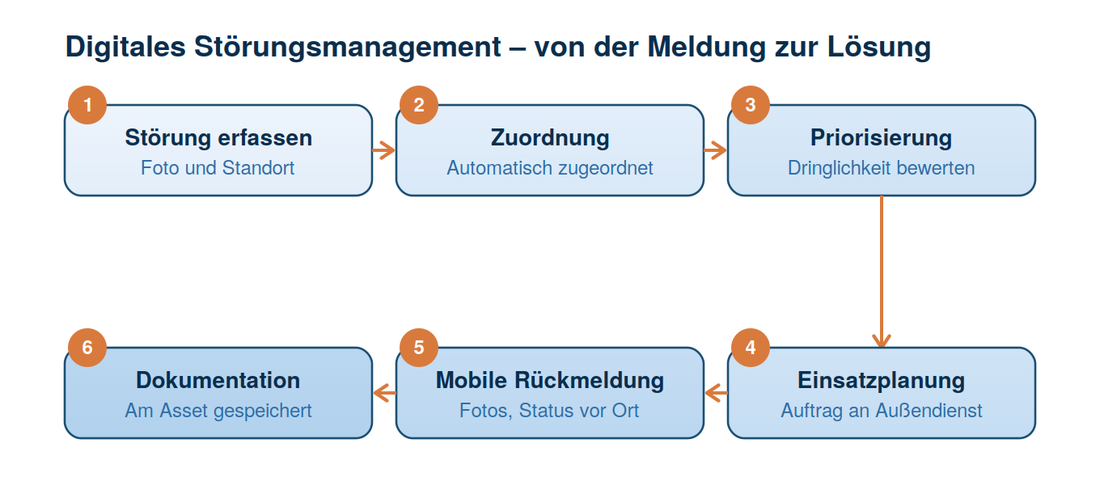
Modern digital incident management typically follows this process:
1. Record the incident
A resident reports a malfunctioning streetlight via stoerung24.de, including a photo and location.
2. Automatic assignment
The report is assigned to the responsible department or directly to the affected system in luxData.easy.
3. Assessment and Prioritization
Staff review the report, assess its urgency, and plan the necessary actions.
4. Dispatch Planning
Field service personnel or a service provider receives the assignment to resolve the issue.
5. Mobile Feedback
On-site, technicians can use mobile apps to document the work performed, attach photos, and update the status.
6. Comprehensive Documentation
All actions are stored directly with the affected asset and are permanently available for analysis, maintenance planning, and record-keeping.
Greater Transparency for Administration and Policy-Makers
Digitized incident management offers more than just operational benefits. The data collected provides important insights for strategic decision-making.
- Municipalities gain answers to questions such as:
- Which types of systems cause a particularly high number of incidents?
In which areas do recurring problems occur? - How long do repairs take on average?
- Which investments improve infrastructure availability in the long term?
This data foundation enables budgets to be allocated more effectively and investments to be prioritized more effectively.
Increase Efficiency and Reduce Costs
The combination of stoerung24.de and luxData.easy creates a seamless digital process without media breaks. Reports are recorded centrally, assigned directly to the relevant systems, and documented until the issue is resolved.
The benefits for municipalities:
- Faster response times
- Higher data quality
- Less administrative burden
- Transparent processing workflows
- Improved communication with residents
- Complete documentation of all actions
- Sustainable optimization of infrastructure management
Conclusion
Today, professional incident management is much more than simply processing damage reports. It combines citizen services, digital processes, and strategic asset management into a holistic approach.
With stoerung24.de, municipalities can record service disruptions easily and in a citizen-friendly manner. Combined with luxData.easy, this creates a powerful platform for managing municipal infrastructure that brings together reports, asset information, and corrective actions in a single centralized system.
The result is faster processes, satisfied citizens, and sustainable management of municipal assets.