Sustainable Lighting Infrastructure in Public Spaces
1,057 metric tons of CO2 and 80% in electricity costs saved: Stadtwerke Celle modernizes street lighting with LED technology and efficient data management
Intuitive software for installing and managing approximately 10,000 lights
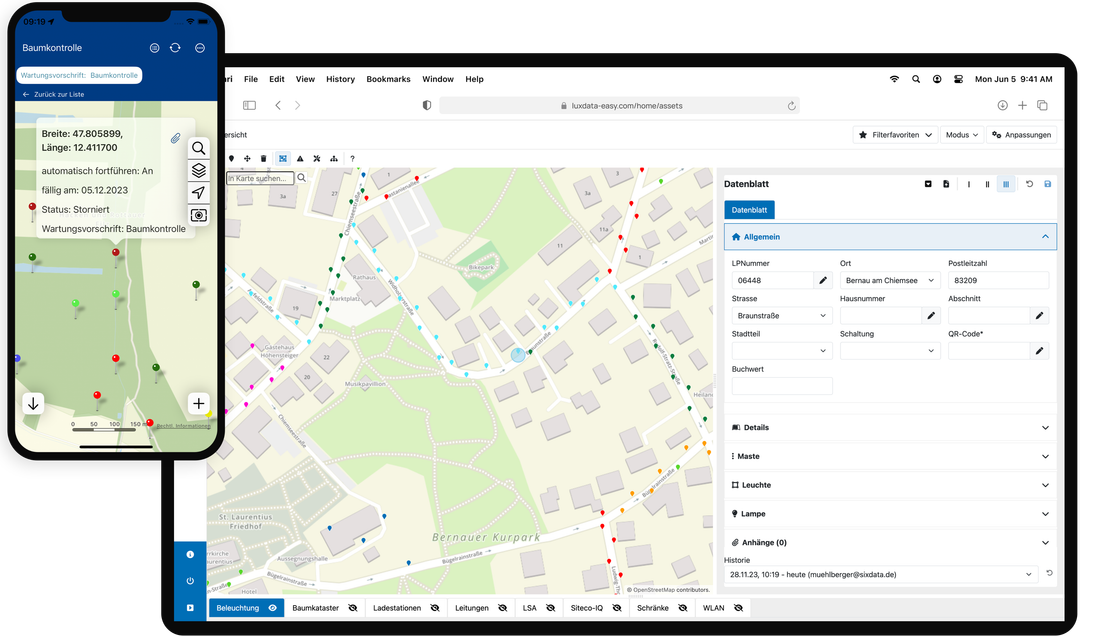
According to the Lower Saxony Climate Protection Act (NKlimaG), the state must reduce its greenhouse gas emissions by 55 percent by 2030 compared to 1990 levels. To achieve this goal while also reducing electricity costs, Stadtwerke Celle has been replacing approximately 10,000 streetlights in the city since March 2023 with modern LED technology. In addition to the lights themselves, the municipal lighting management system is also being upgraded. This is where the web application luxData.easy from sixData GmbH comes into play: With the help of this lighting management software, all data from every light can be seamlessly recorded and documented. luxData.easy simplifies the assignment of luminaire data through a QR code scanning function and enables direct transfer to the Siteco app, allowing customers to adjust the luminaire via Bluetooth for parameters such as light intensity or switching times. For this purpose, the operating data can be accessed and updated in an intuitive dashboard. In total, the municipal utility is investing 4.5 million euros in the LED retrofit and expects to reduce CO2 emissions by 1,057 metric tons and cut annual electricity consumption by at least 80 percent. The Federal Ministry for Economic Affairs and Climate Action (BMWK) is providing approximately 1.35 million euros in funding for the project.
Climate change has long since arrived in Lower Saxony and is already having a demonstrable negative impact on nature and people. This was the conclusion reached in the first Climate Impact Monitoring Report, published by the Lower Saxony Center of Excellence on Climate Change (NIKO) in 2023. The report supports the Lower Saxony Climate Protection Act, which mandates a massive reduction in greenhouse gas emissions by 2030. The initiatives and measures are intended to make Lower Saxony the “No. 1 climate protection state”—and were the deciding factor for Stadtwerke Celle to modernize and, in the process, digitize the street lighting throughout the entire city. In total, the project involves approximately 10,000 streetlights. Celle is benefiting from the National Climate Protection Initiative, under which the Federal Ministry for Economic Affairs and Climate Protection is providing 1.35 million in funding for the project. With a total investment of 4.5 million euros, the city aims to reduce CO2 emissions by approximately 1,057 metric tons per year. In addition, electricity consumption is expected to drop by 80 percent without compromising traffic safety for pedestrians and vehicles due to reduced lighting.
Replacement of Fixtures and New Lighting Management
For this massive project—replacing all conventional street lighting with LED technology—Stadtwerke Celle issued a call for bids. The lighting manufacturer Siteco was able to meet the required technical specifications and, together with the general contractor Westenergie Netzservice GmbH, which was responsible for installation and documentation, was awarded the contract. The renovation finally began in March 2023. “With such a large project involving this level of complexity in documentation and simultaneous inventory taking, it usually requires an enormous amount of effort to record and track everything correctly,” notes Bejtus Berisa, Sales Manager for Network Services North at Westenergie. “Since we move from area to area, we also always have to check in advance exactly which of the nine luminaire types and six different cable lengths we need for each section.”
In addition to the parameters of the luminaire and the lighting point itself, the required documentation also includes information on incoming cables, location data, photographic documentation, and test reports—for each of the 10,000 lighting points. When managing these massive amounts of data, however, Westenergie does not have to struggle with conventional spreadsheet programs: Instead, the utility provider uses the luxData.easy web application from sixData as well as the luxData.easyApp. “Using QR codes, Westenergie employees can capture each individual lighting point with a simple scan using their mobile devices and effortlessly enter the respective parameters,” explains Armin Mühlberger, Managing Director at sixData. “At the same time, all technical data for the LED luminaire can be retrieved from the Siteco server via the scanned QR code.” The Celle municipal utility can flexibly adjust the light intensities and switching times of the luminaires via the Siteco IQ system with no additional effort.
Easy Management of Lighting Infrastructure
The luxData.easy software offers a wide range of benefits that are particularly evident in complex projects, such as the conversion of street lighting to LED technology. A key benefit is efficient data collection and documentation: Using the QR code scanning feature, all necessary parameters for lighting points, luminaires, and cables can be recorded quickly and easily. The ability to flexibly create data fields and transfer them directly into the software on-site saves a great deal of time and makes the entire management process significantly more efficient. This substantially reduces manual effort, and the data is accurately documented at all times.
The software’s support for project management is also particularly noteworthy. “All relevant project information is recorded centrally and clearly, which greatly simplifies the coordination and monitoring of large and complex projects.” As a result of these measures and the functional testing, a test report is generated. This information is then entered into Stadtwerke Celle’s GIS system. “This user-friendliness and efficiency make luxData.easy an indispensable tool and contribute significantly to the success of such ambitious projects,” says Bejtus Berisa, Sales Manager for Network Services North at Westenergie.
With the successful completion of the LED street lighting project in just one and a half years, Celle is not only setting an example for sustainable urban development but also demonstrating how modern technology and forward-thinking planning can contribute to significant savings and genuine climate protection—a model project that is attracting attention nationwide.